Glendale, Skye - Tourist Guide

Whale-Watching in Glendale, Isle of Skye
Cetaceans at Neist
Neist Point in Glendale is undisputedly the finest place on the Isle of Skye for watching whales, dolphins, porpoise and basking shark, with pods being resident from May through to September. The peak months are June and July, when sightings of Minke Whales become almost a daily event.
The Minke Whales often approach within 5 to 10 metres of the shore, giving spectacular views and the amazing opportunity to hear them 'blow' as they surface.
To get the best views, choose a day when the sea is flat calm and pick your way carefully to the water's edge between the end of the point and the lighthouse. Find a comfortable rock, with a good view either side, sit and wait... patiently!
Minke Whales
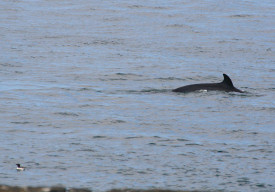
Minke Whale & Razorbill by the shore at Neist.
The length of an adult Minke Whale is 7-10m (23-33ft) and the dorsal fin is located two thirds of the way along its body, i.e. at the tail end. In the above photograph, the length of the whale's body above the surface is around 3 metres.
A razorbill measures 0.4 metres from beak to tail.
Minke Whales often carry distinguishing marks, such as the one in the photograph (top right) that has a red, diagonal scar (\) on its left flank below the dorsal fin. Their commonest colouration is jet black but some individuals, believed to be juveniles, appear blueish with pale flanks.
For the closest views, Neist Point is the best place on Skye. They are also regularly seen off Lower Milovaig and have come inside Loch Pooltiel.
Common Dolphins
Common Dolphins are regularly seen in the Minch off Lower Milovaig and also off Neist Point during the summer months. They are also seen occasionally in Loch Dunvegan as far up as the Three Chimneys at Colbost.
Basic Identification Tips
These are the basic features that distinguish Glendale's commonest cetaceans:
- Minke Whale - Long, shallow, black profile on the surface, making a slow, wide roll, with small, hooked, dorsal fin appearing last.
- Harbour Porpoise - Very small, with a small, centrally-located equilateral-triangle fin. Fairly fast, tight turn at the surface, with little more than the fin shown.
- Dolphins - Very fast moving. When submerged, they cause the surface of the water to boil violently. Breech often and never stop moving. Large, hooked fin, centrally-located on the body.
- Basking Shark - Very slow moving, just floating on the surface with their nose, large (triangular-to-round) dorsal fin and tail fin protruding out of the water. Very large, open mouth that is white inside. They do occasionally sink below the surface for long periods.
- Grey Seal - Often float with just their heads out of the water and nose pointing skywards, called 'bottling'. Inexperienced observers, who have seen 'Flipper' movies, or watched captive dolphin displays, often mistake these for dolphins. Wild dolphins never stop moving.
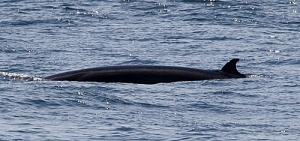
The characteristic profile of a surfacing Minke Whale.

Minke Whale at Neist Point.
Recent Cetacean Sightings
21st Apr 2024

Minke Whale - Neist
April 2024
There was a minke whale off Neist at mid-day that did one close pass but mostly remained quite distant. There were two harbour porpoises close to shore at Neist at mid-day.
31st Mar 2024

Minke Whale - Neist Point
March 2024

Harbour Porpoise - Neist Point
March 2024
There were two minke whales back at Neist Point, the first of the year, and two harbour porpoises.
25th Feb 2024
There were two distant harbour porpoises off Neist Point at mid-day.
More recent wildlife sightings
Killer Whales (Orcas)
Killer whales are occasionally seen off the Neist Point and Milovaig. They have a distinctive large, upright dorsal fin.
Porpoises
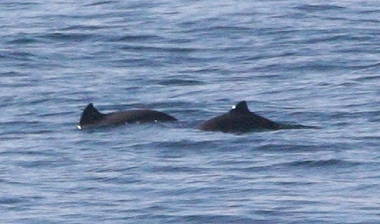
Porpoises at Neist Point.
Harbour Porpoises are most often seen in the mouth of Loch Pooltiel, off Meanish Pier, with pods of up to 12 being present throughout the Summer. Another fairly good place for them is Moonen Bay, very close inshore, at the point where Loch Mor flows into the sea.
Basking Sharks
Basking sharks are Britain's largest fish and are totally unrelated to true sharks. They float around with their white, dustbin-like mouths wide open hoovering up plankton.
They are very common in the sheltered coves around Neist, Oisgill and Milovaig during the Summer months.